Profile view of a bearded man wearing a dark baseball cap and a dark gray T-shirt against a plain off-white background.

Signs your air ducts need cleaning in Florida

Duct and vent cleaningDucts or ventsFlorida
Step 1 of 2

What ZIP code is the job in?

What are the signs your air ducts need cleaning in Florida?

You've noticed something off, maybe dust settling faster than it used to, or a musty smell when the AC kicks on, and you're wondering if it's the ducts behind it. In Florida, where the air conditioner runs most of the year and humidity is always in the mix, it's worth catching this early rather than waiting for it to turn into a bigger problem.

Dust, musty smell and uneven airflow are the signs to watch

Dust that collects fast on furniture, a musty smell when the air kicks on, and rooms that get less airflow than others are the main signs. Humidity here means ducts can hold onto moisture longer than they would in a drier climate, and that moisture is what lets dust build into something that smells. If you run the AC most months of the year, air is moving through those ducts constantly, so whatever is sitting in them gets circulated into the house over and over. A vent that looks dusty on the outside usually means buildup further in. Dark spots around the vent covers or a rise in how often you're changing the filter point the same direction.

Unfinished basement with bare concrete floor and walls, exposed wood joists, large galvanized sheet-metal ductwork, PVC and copper piping, and a gray furnace unit beside wood stud framing.

Ducts running clean

Air moves through the system without carrying anything extra with it. No film on the vent covers, no smell when the AC cycles on, no haze settling on furniture faster than you'd expect. The metal stays dry and the joists around it stay clear.

Basement ceiling with large galvanized sheet-metal ductwork, round metal pipes and plumbing lines running beneath wood joists, above a bare concrete wall and floor.

Ducts in trouble

Water has found its way into the space where the ductwork runs, and the staining on the foundation wall shows it. Moisture near the ducts in a Florida basement gives mold something to grow on, and once it's inside the metal, every cycle of the AC pushes it through the house.

Clean Now or Wait It Out

Clean them now

  • You catch the problem before dust has a chance to settle into the insulation around the ducts.
  • A cleaning crew can work on a schedule that fits you, instead of one forced by a bigger issue later.
  • Florida's humidity makes mold take hold fast once it starts, so clearing ducts early keeps it from spreading into the furniture and carpets a haze eventually settles on.
  • Smaller debris and dust buildup come out easier than a duct system that has gone years without attention.
  • You get ahead of the musty smell before it becomes the first thing visitors notice when they walk in.

Wait and watch

  • You risk the dust and film building up long enough that it starts coating vent covers and nearby surfaces.
  • A musty smell that comes and goes now can turn into one that's there every time the AC kicks on.
  • Mold that gets a foothold in humid Florida air spreads through ductwork faster than it would in a drier climate.
  • Waiting means a cleaning crew may find more buildup packed into the metal than if you had called sooner.
  • The joists and framing near the ducts stay exposed to whatever moisture or debris keeps accumulating.
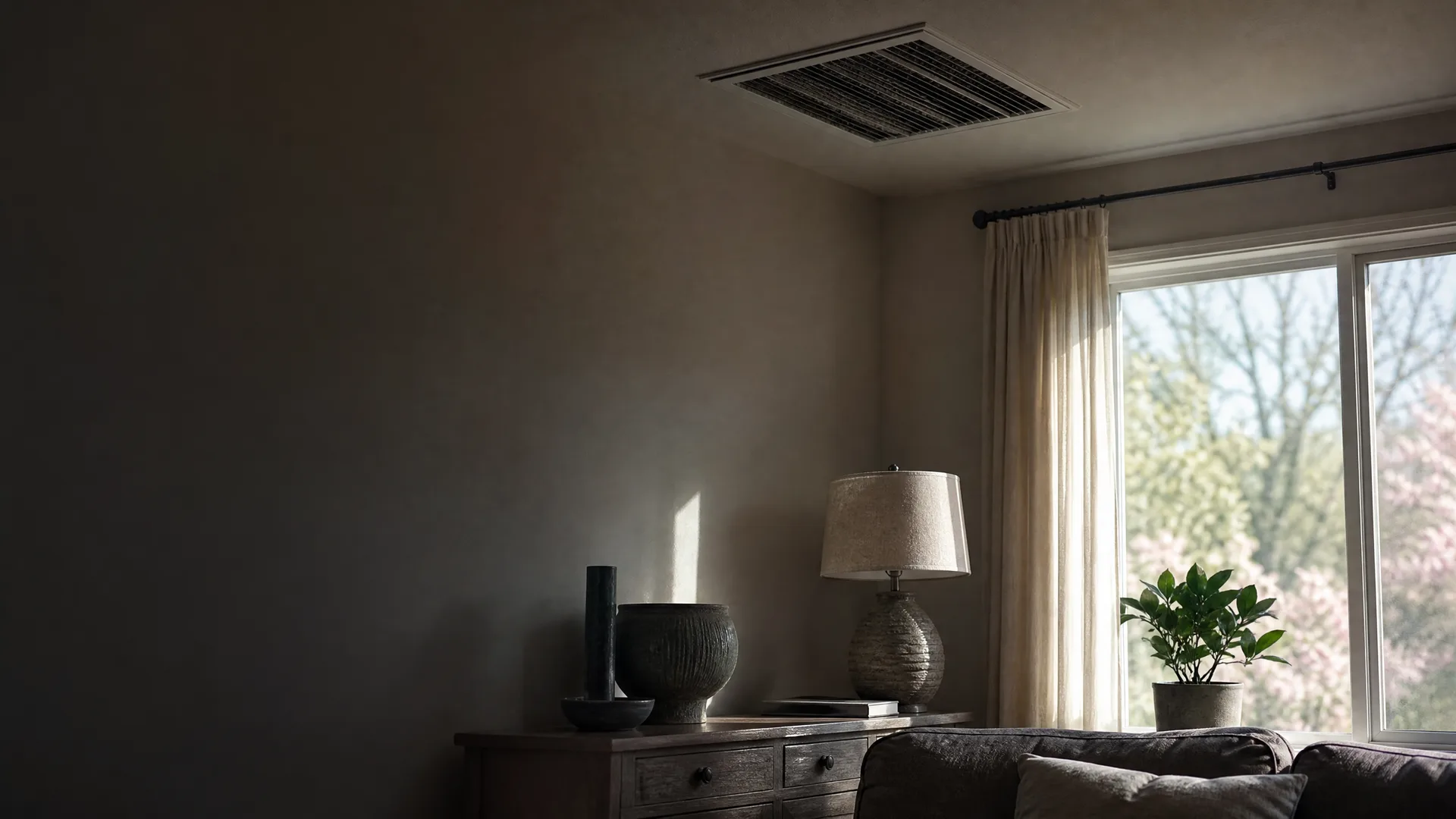
A dim living room corner with a ceiling air vent, a curtained window showing blossoming trees, a table lamp and dark ceramic vessels on a wooden dresser, a potted plant, and a sofa in the foreground.

It's a Saturday morning in April, sun coming in flat across the living room. You're running a hand along the top of the TV stand and it comes away gray. You look up at the ceiling vent and the grille has a soft dark fuzz along every slat, thicker than you remember from last year. The coffee table has the same film, and so does the lamp shade behind the couch. You wipe the table down, and by the time you've finished the vent, the table already looks like it needs doing again. The AC clicks on and you catch that faint musty smell you've been noticing for a couple of weeks now.


Stop chasing a duct system pro

You already know what you saw, the dust, the smell, the film on the vent covers. What's left is deciding whether to deal with it yourself or hand it off. Finding a duct cleaning crew in Florida usually means searching through a list of companies you've never heard of, calling a few, explaining the same thing about the musty smell and the dust three or four times, then sitting on quotes trying to tell a fair price from a lowball one. That's the part this page takes off your plate. Send the request once and a contractor who does this work takes it from there. No list to work through, no retelling the story to the next person who picks up. With the humidity here, mold and dust in the ducts don't wait for a convenient week. The sooner someone capable is looking at it, the sooner you stop thinking about that gray film every time the AC kicks on.

Why Florida ducts load up faster

Air conditioning here runs most months of the year, which means more air moving through the same ducts than a house in a milder climate ever sees. Every pass carries a little dust and whatever else is floating in the house, and some of it sticks to the inside of the duct instead of coming out the vent. The humidity adds to it. Moist air inside a duct gives dust something to cling to, so it builds up faster than it would somewhere dry. More running hours plus more moisture means the buildup you'd expect after years somewhere else can show up here in less time.

What a dirty duct does to airflow

A duct isn't just a pipe, it's a path, and anything coating the inside of that path narrows it. Dust and debris built up along the walls of the ductwork reduce how much air actually gets through to the vent. The AC still runs the same, the blower still spins the same, but less air reaches the room, so it takes longer to cool and the system cycles more to make up for it. You won't see this part. You'll feel it as a room that never quite gets as cool as the thermostat says it should.

A smiling man in a blue denim shirt over a white tee sits at a light stone kitchen counter with a grey mug and a bowl of oranges and bananas, with pendant lights and shelving behind him.
A smiling bearded man in a grey long-sleeved shirt sits at a kitchen counter with a dark mug, with a dining table, pendant light and glass doors onto greenery behind him.
A bearded man in a dark green knit sweater smiles and looks off to the side while standing at a kitchen counter with a white mug of coffee, with open shelving, a potted tree, and a dining table near large windows behind him.
A man with dark curly hair in a dark green sweater stands smiling and looking to the side in a kitchen with white cabinets, a potted plant, a stone countertop with a ceramic mug, and a dining area with framed art in the background.

Left alone

Dust keeps settling into the insulation and the coil keeps collecting what the air carries. Florida's humidity gives mold a head start once it has something to grow on inside the duct.

Send my request

Cleaned now

You stop the buildup before it reaches the coil or the insulation. One call, instead of hunting down a crew and explaining the problem over and over to each one.

Send my request

Why does the house feel dustier than it used to

You dust the shelves and by the end of the week there's a new layer. The return vent has a gray fuzz along the slats that wasn't there last year. Someone in the house is sneezing more, or the air feels thicker than the thermostat setting explains. Sometimes it's a smell, a musty note that shows up the second the AC kicks on and fades once the air's been moving a few minutes. None of this means the ducts are failing. It means they're holding onto more than they should, and in a house where the AC runs most months of the year, whatever's sitting in there keeps getting pushed back into the rooms you're standing in.

  1. A tech opens each vent cover and checks for buildup first.

  2. A camera goes into the ducts to find mold or blockage.

  3. A vacuum system attaches to the ductwork to pull debris out.

  4. A brush or air tool knocks loose dust stuck to the walls.

A smiling bearded man in a green t-shirt sits on a gray sofa, looking down toward a device at the bottom of the frame, with a bookshelf and a green plant blurred behind him.
A bearded man in a plaid flannel shirt stands indoors looking out a window at snow-covered conifers, with a ceramic mug on the wooden sill and wooden cabinets behind him.

Power costs 15.21 cents per kilowatt-hour statewide

Your AC runs most of the year here, and at 15.21 cents a kilowatt-hour, every hour it fights dust and grime caked inside the ducts costs you. Clogged, dirty ducts make the system push harder to move the same air, and that shows up on the bill before it shows up anywhere else.

EIA-861 2025 statewide residential average

The signs are the ones you already noticed: dust that comes back fast, a musty smell when the AC kicks on, a grille with fuzz along the slats. In Florida, where the system runs most of the year, those signs show up sooner than they would somewhere milder, and they don't go away on their own. A cleaning now deals with what's already built up before the humidity gives mold a better hold on it. What's left isn't figuring out whether something's wrong. It's deciding what to do about it, and that's the part that eats time, calling around, explaining the same thing to every company you find, trying to tell which quote is fair. Send the form and that part is done. You're not left searching through names you don't recognize or waiting on callbacks that don't come. Someone qualified gets matched to your job, and the dust along that grille stops being something you have to solve on your own.

A dark wood cabinet with a paneled door and a ceramic pot of green foliage on top stands in a beige-walled room with white baseboard, a window at left, hardwood floor, and a patterned area rug.
A dark wood glass-front cabinet holding folded towels, woven baskets and a ceramic vase stands in a bathroom corner beside a window, with a potted fern and stacked towels on top and a freestanding tub partly visible at left.
A woven basket holding a green cushion and a cream fringed knit throw sits on a wood floor in a room corner beside a window and a dark wooden cabinet.
Corner of a room with a dark wood cabinet topped by a round vase, a linen curtain at a window, white baseboard, oak plank flooring with sunlight patches, and a woven jute rug in the foreground.
A dark wood sideboard against a pale wall holds a shallow stone bowl and a round ceramic vase with leafy branches, with sunlight from a curtained window falling across the wall, wood floor and woven rug.

Finding a pro stops being your job

Explain the job once and skip repeating it on every call.

Describe it once

Asking costs nothing, and the choice to hire stays yours.