Mini Split Installation in St. Petersburg, FL
A new system here will heat from January through January and cool from March through December every year. Tell us about the house, and a licensed contractor who covers Pinellas County will get in touch.
Tell us about the job
It takes about a minute.
Your mini-split will run almost all year here
In St. Petersburg, a mini-split works nearly eleven months of the year. Cooling runs March through December, with summer afternoons averaging 90°F. The only real break comes in January, when winter lows average 54°F. There is barely an off season for the compressor to rest.
A new unit installed today has to meet the federal minimum of 14.3 SEER2 for cooling and 7.5 HSPF2 for heating. In this climate, the cooling side of that rating matters far more than the heating side ever will. Power is worth planning around too. Florida saw 38% of households lose power for at least 24 hours in 2024, and this area has logged 60 damaging wind events over the past ten years. A mini-split that comes back on by itself once power returns is one less thing to deal with after a storm.
- 1 months
- January through January, your system heats
- 10 months
- March through December, it cools
- 54°F
- the average winter night it heats against
- 90°F
- the average summer afternoon it cools against
NOAA nClimDiv, 1991–2020 normals
Florida requires HVAC contractors to hold a state license.
The Construction Industry Licensing Board tests contractors before it licenses them, and the license belongs to the contractor, not to any single job. That means the company that puts in your mini-split is the one the state has checked and the one on record, not just the crew that shows up that day.
Most cities and counties in Florida will still require a permit from the local building office for this installation, along with an inspection once the work is finished. That check is separate from the state license and happens at the address, not through the licensing board.
Sources: Florida Legislature · Florida Department of Business and Professional Regulation
- Is a mini split worth it?
- For most homes here, yes. Cooling is needed nearly ten months a year in St. Petersburg, and a mini split handles that load without ducts losing air along the way. It also covers the short winter stretch, since a heat pump moves heat in both directions. Whether it makes sense for your house depends on how it's laid out and what you're heating or cooling now, so a contractor should walk through that with you.
- How many rooms can a mini split cover?
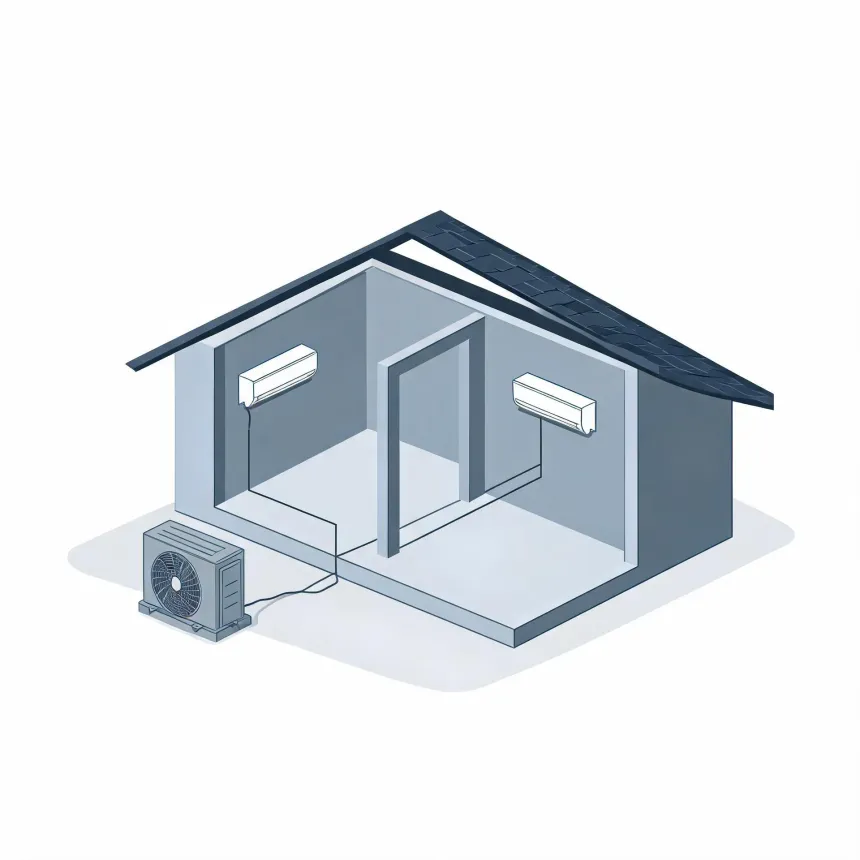
- A single outdoor unit can run one indoor head or several, depending on the system. Single-zone systems cover one room or open area. Multi-zone systems tie several indoor heads to one outdoor condenser, with each head controlled on its own. How many rooms one setup can reasonably cover comes down to the size of each space and how the house is laid out, which is something a contractor needs to measure in person.
- Can a mini split heat a whole house?
- It can, if enough indoor heads are placed to reach every room. A ductless heat pump moves warm air directly into the space each head is mounted in, so rooms without a head stay dependent on the air drifting in from nearby ones. Given that heat is only needed here in January, a mini split sized to cover the main living areas often does the job. Covering the whole house evenly takes planning around room sizes and layout, which a contractor works out before installing.