Mini Split Installation in Tampa, FL
A new system here will heat from December through January and cool from March through November every year. Tell us about the house, and a licensed contractor who covers Hillsborough County will get in touch.
Tell us about the job
It takes about a minute.

Eleven months of the year, your mini-split is working
Cooling runs March through November here, nine months, with summer afternoons averaging 91°F. Heat only takes over in December and January, when nights average 52°F. That leaves one month where the system isn't doing either job.
A mini-split manufactured from 2023 on has to meet 14.3 SEER2 for cooling and 7.5 HSPF2 for heating, the federal minimum for split systems. Power is worth planning around too. Across Florida, 38% of households went at least 24 hours without power in 2024, and the area has seen 63 damaging wind events over the past ten years. Whoever installs your unit should mount it and its disconnect with that in mind.
- 2 months
- December through January, your system heats
- 9 months
- March through November, it cools
- 52°F
- the average winter night it heats against
- 91°F
- the average summer afternoon it cools against
NOAA nClimDiv, 1991–2020 normals
Florida requires HVAC contractors to hold a state license.
The Construction Industry Licensing Board tests and records every HVAC contractor the state licenses, and that record stays with the contractor, not with any single job. So the license on the wall or the truck door is tied to the person doing your install, not reissued each time they take on a new house.
For a mini-split install in Hillsborough County, that state license is what stands behind the work itself, the refrigerant lines, the wiring, the mounting. Beyond that, most cities and counties also require a permit from the local building office before the work starts, with an inspection once it's done. That inspection is a separate check on the installation, done by someone other than the contractor who performed it.
Sources: Florida Legislature · Florida Department of Business and Professional Regulation
- Is a mini split worth it?
- For Tampa, yes, especially in a room your central system doesn't cool well or a space that had no ductwork at all. Cooling runs nine months a year here, so the system gets used most of the year, not just a few weeks. It also handles the December and January cold without a separate heater, since the same unit heats and cools. A contractor can look at the room and tell you whether a mini split or another fix makes more sense for it.
- How many rooms can a mini split cover?
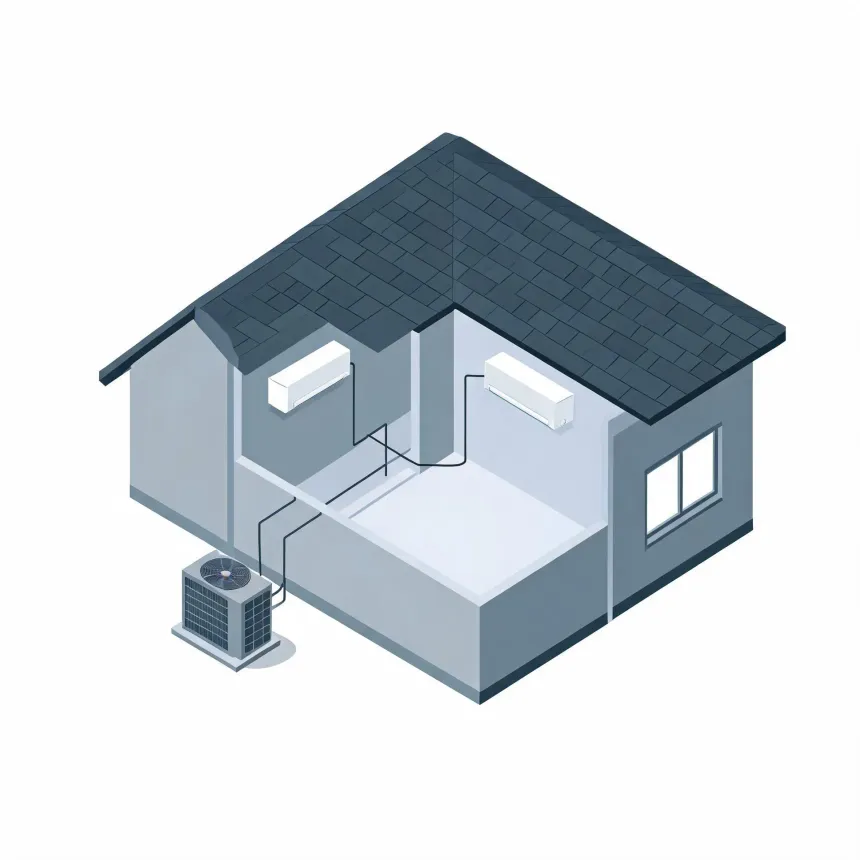
- A single-zone mini split covers one room or one open area. If you need more than one room done, a multi-zone system connects one outdoor unit to several indoor heads, each with its own thermostat, so you can cool the bedroom and the living room separately. How many zones one outdoor unit can run depends on the unit's capacity and the size of each room. A contractor will size that against the actual rooms in your house.
- Can a mini split heat a whole house?
- A multi-zone mini split can heat a whole house if it has enough indoor heads placed to cover every room, and Tampa's mild winters make this realistic. Nights average 52°F from December through January, well within what a heat pump handles without backup heat. What it takes is matching the outdoor unit's capacity to the whole house, not just one room. A contractor can size a system against your home's layout and tell you if whole-house coverage makes sense there.