







Musty smell from vents in Fort Lauderdale, FL

Hand off the search

A musty smell coming out of your vents in Fort Lauderdale usually means something is holding onto moisture back in the duct system, and with the air here staying thick and damp most months of the year, that smell doesn't tend to clear up on its own. You could spend an afternoon searching for duct cleaning companies, calling a few, explaining the smell and where it's worst in the house, then waiting on quotes to compare. Or you could send one form and let that part go. Once it's sent, you're not the one tracking down who's available or sorting through who actually answers the phone. That work moves off your plate and onto someone who does this daily in Broward County homes. The button below starts that. It costs you a couple of minutes now instead of an afternoon of calling around.

Why do my vents smell musty in Fort Lauderdale?

You keep catching that musty smell every time the AC kicks on, and you want to know what's actually causing it before it turns into something worse. It's not just unpleasant. A smell like that usually points to moisture sitting somewhere it shouldn't, and you'd rather deal with it now than wait until it spreads through the house.

Moisture is collecting inside your ductwork, usually around the coil

Your air conditioner pulls humidity out of the air as it cools, and that moisture has to go somewhere. Most of it drains off, but some settles on the evaporator coil and the duct surfaces nearby. Mold and mildew grow on that damp surface, and the smell travels through the ducts every time the system runs. In Broward County the air stays humid most of the year, so that moisture gets replaced almost as fast as it clears. A dirty filter or a clogged drain line makes it worse by slowing airflow and giving water more time to sit. Once mold has a foothold in the ducts, running the system longer just pushes more of that smell into the rooms you're in.

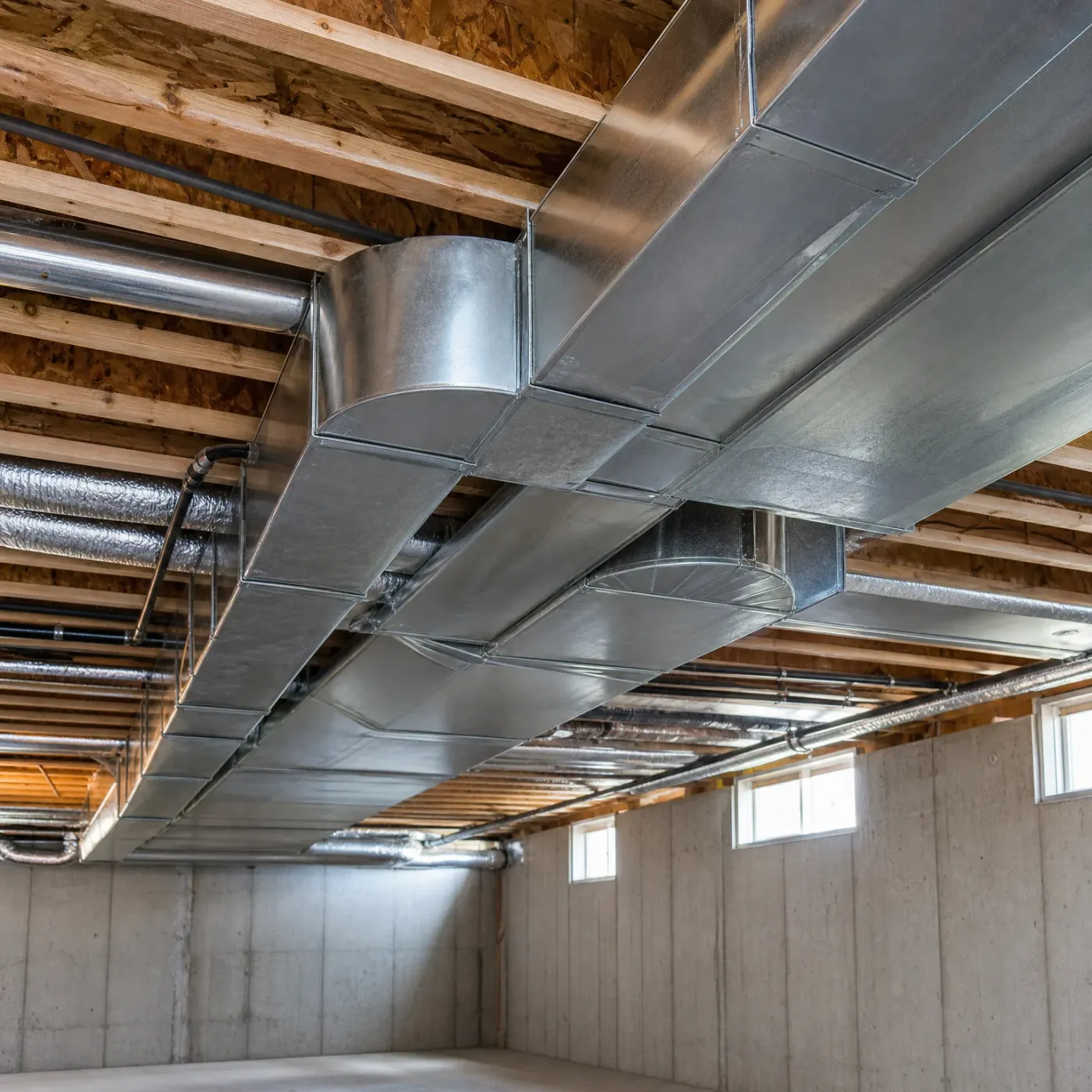
Empty unfinished basement with concrete walls and floor, exposed wood joists, metal HVAC ducts and pipes overhead, and a steel support column near a framed wall.
Air moving through clean, dry ductwork like this carries no odor into the rooms it reaches.
Empty basement with bare concrete walls and floor, a steel support column, and galvanized sheet-metal ductwork and pipes running along the exposed wood joist ceiling.
Ductwork holding moisture like this breeds the mildew smell that drifts out every time the system runs.

Where the smell actually starts

  • Your AC's evaporator coil sits wet every time it runs, and that moisture drips into a pan below it.
  • A drain line carries that condensate away, and in Broward County's humidity it runs almost constantly from April through October.
  • If that line clogs or drains slowly, water sits in the pan and on the coil longer than it should.
  • Standing water on a warm coil grows mold within days, and the blower pushes that smell straight into your ducts.
  • Dust inside the ductwork holds onto that moisture too, so the smell lingers even after the coil dries out.
  • A dirty filter restricts airflow across the coil, which keeps it wetter longer and feeds the same problem.

The coil inside your air handler cools air by pulling moisture out of it, and that moisture has to go somewhere. It runs down into a drain pan, then out through a condensate line that usually empties into a drain near the unit or outside near your foundation. Down here, with the system running most of the year, that line is doing steady work. Algae and dust build up inside it over time, the same way they would in any drain that rarely dries out. Once it slows down or blocks, water backs up into the pan instead of draining away, and it sits there against a coil that's still cold and wet from the last cycle.

That combination, standing water and a surface that doesn't fully dry between cycles, is what mold needs. It doesn't take long to take hold once conditions are right. The blower fan that pushes air through your home pulls air across that coil first, so whatever's growing there rides along into the ductwork. Dust already sitting inside the ducts absorbs some of that moisture and holds the smell even after the coil itself looks fine again.

A dirty filter makes the whole cycle worse. Restricted airflow means less air crossing the coil, which means it stays wet longer between cycles instead of drying out. The smell you're noticing at the vents is usually the last step in a chain that started at the drain line or the filter.

A smiling man in a green long-sleeve shirt stands at a dark kitchen counter with a ceramic mug, with wood cabinets, white tile backsplash, and a window and dining table behind him.
A smiling man with wavy dark hair and a beard, wearing a navy sweater, sits at a kitchen counter with a gray mug, with a dining table, potted plant and windows behind him.
A bearded man in a dark green sweater smiles and looks to his right while seated at a white kitchen counter with a gray mug, with windows and greenery behind him.
A smiling man in a dark navy sweater stands in a home interior beside a counter with a white mug, with a kitchen, hallway and potted plant in the background.
Unfinished basement with concrete walls and exposed wood joists, with large galvanized sheet metal HVAC ducts, insulated flex duct, and pipes running along the ceiling, and small windows near the top of the walls.

Stop chasing a duct system pro

Explain the job once and skip repeating it on every call.

Send it once and finding someone is no longer on you.

Skip the search

It costs nothing to send, and you don't have to hire anyone.

Does the smell only show up when the AC is running

You probably notice it most in the first minute after the AC kicks on, then it fades once air has been moving a while. It might be strongest in one room and barely there in another, depending on which vent is closest to the problem. Some households stop noticing it at all because they've been smelling it for months and it's become normal to them, while a guest walks in and catches it right away. The towels in the hall closet or clothes left in a bedroom with the vent nearby can start picking up that same musty note. Left alone, the moisture behind that smell gives mold something to keep growing on inside the ductwork, where it's out of sight and not going to clear up on its own.

Unfinished basement with concrete floor and walls, exposed wood joists, steel support posts, and large galvanized sheet-metal ductwork running to a furnace or air handler against the far wall.

Ducts moving dry air

This is what a duct system looks like when it's not causing problems. Air moves through metal supply and return runs with nothing sitting inside them to grow mold or hold a smell. Nothing here traps moisture, so nothing here feeds an odor.


Galvanized sheet-metal ductwork and round pipes run along a wooden floor joist ceiling above a bare concrete wall and floor.

Ducts holding moisture

This is where that musty smell starts. Moisture sitting in the ductwork, often from a clogged condensate line or a return pulling in damp air, gives mold something to grow on. Every time the system runs, it pushes that smell through the vents and into your rooms.

Empty basement with bare concrete walls and floor beneath an exposed wood-joist ceiling carrying galvanized sheet-metal ductwork, round ducts and pipes.
Before you get your ductwork cleaning
Unfinished basement with bare concrete floor and walls, exposed wood joists, metal ductwork, a furnace unit, steel support posts, and a small window.
After you get your ductwork cleaning

April through October

That's how long the AC runs almost nonstop here, and every one of those months, condensation is forming on the coil and moving through the drain line and ducts.

Send my request

One clogged line, system-wide smell

A single blocked drain or damp stretch of duct is enough to send musty air out of every vent the system feeds.

Send my request
A smiling man with short dark curly hair and stubble, wearing a navy T-shirt, sits on a beige sofa looking down toward a dark object in the foreground, with a living room, round mirror, lamp and bright window behind him.
A man with graying hair and a beard in a plaid flannel shirt stands indoors looking out a frosted window at snow-covered trees, with a ceramic mug on the sill.

Half the homes here were built by 1980

Half the houses in Broward County went up in 1980 or earlier. If yours is one of them, its ductwork has had decades of humid Florida air moving through it, and older duct runs are more likely to have joints, insulation or seams that hold onto moisture instead of letting it pass through.

ACS 2020-2024

A closed laptop and a ceramic mug of dark coffee sit on a wooden table, with a blurred kitchen counter, potted plant, wooden utensils and cutting boards, and a large window in the background.

A musty smell from your vents means moisture is sitting in your ductwork

That's the whole answer. Something in the system, usually the drain line or the ducts themselves, is holding onto water instead of letting it drain and dry, and mold is growing on it. A duct cleaning removes what's built up in there so air can move through clean metal again instead of picking up that smell on its way to your rooms.

Finding someone to do that work is its own chore. You'd be searching for duct cleaners who actually serve Broward County, calling a few to see who answers, explaining the same smell and the same symptoms over again each time, then weighing quotes against each other without much way to tell one company from the next. Send the form on this page and that part is done. You won't need to track down who's available or repeat your situation to three different voices on the phone.

Interior corner of a living room with a beige upholstered armchair holding a textured pillow and throw, a eucalyptus arrangement in a ceramic vase on a wooden table in the foreground, a blurred glass-front cabinet behind, and a potted plant on a sunlit window sill.
A single-story white stucco house with dark roof, stone-clad entry tower and three dark garage doors, lit from within at dusk, with a curved concrete driveway and dark mulch beds with boulders and bare young trees in the foreground under an orange and blue sunset sky.

Ductwork Cleaning

Finding a pro stops being your job

Duct and vent cleaningDucts or ventsBroward County, FL
Step 1 of 2

What ZIP code is the job in?

  • A pale ceramic vase holding leafy green branches sits on a wooden side table beside a linen-covered chair with a throw blanket, below a wood-framed window.
    • Get matched with a pro who works on ducts in Broward County.
    • Your request goes to a Broward County pro who takes ductwork jobs.
  • A large woven basket with rope handles holding a draped cream fringed blanket stands in a room corner on a wood floor, with sunlight from a nearby curtained window and a dark wood cabinet at right.
    • Once you send the form, finding a pro is off your list.
    • After you send the request, you're done searching.
  • A leafy green plant in a woven basket sits in a sunlit corner beside a beige sofa with a knit throw, sheer curtains, a window, and a wooden coffee table.
    • Skip calling around for someone who cleans ducts.
    • Answer a few questions about the duct cleaning and skip the search.
  • A ceramic vase holding olive branches and a wooden bowl sit on a wooden windowsill beside a white-framed window, with a framed picture leaning against the grey wall.
    • A licensed pro who works in Broward County gets your request.
    • Your request stays with one local pro.