Mini Split Installation in Palm Bay, FL
A new system here will heat from January through January and cool from March through December every year. Tell us about the house, and a licensed contractor who covers Brevard County will get in touch.
Tell us about the job
It takes about a minute.
Palm Bay asks a mini-split to cool almost all year
Cooling runs March through December here, ten months of the year, with summer afternoons averaging 90°F. Your mini-split's compressor is doing real work most months, not just a few peak weeks. Heat only matters in January, when nights average 54°F, so this is a system that spends nearly its whole life cooling, not heating.
A new unit installed now has to meet the federal minimum of 14.3 SEER2 for cooling and 7.5 HSPF2 for heating. Most homes here heat with electricity, and outages are common enough in Florida that it's worth asking your contractor how the system comes back on once power returns.
- 1 months
- January through January, your system heats
- 10 months
- March through December, it cools
- 54°F
- the average winter night it heats against
- 90°F
- the average summer afternoon it cools against
NOAA nClimDiv, 1991–2020 normals
Florida requires HVAC contractors to hold a state license.
The Construction Industry Licensing Board tested this contractor before handing out that license, and it keeps a record of who holds one. That license belongs to the contractor, not to the mini-split going into your home. It tells you the state has already checked this person's qualifications once, not that it checks each job they take on.
For your installation, Brevard County's building office is the one that checks this particular job. Most cities and counties in Florida require a permit to install a mini-split, and an inspection once the work is finished. That inspection is what confirms the wiring and refrigerant lines were done right in your house, separate from whatever the state already decided about the contractor holding the license.
Sources: Florida Legislature · Florida Department of Business and Professional Regulation
- Is a mini split worth it?
- For most homes here, yes. Cooling runs from March through December, and a mini split handles that load without losing air through ductwork the way a central system can. Palm Bay afternoons reach 90°F in summer, and a mini split cools the rooms it serves directly. Winters are short and mild, down to 54°F at night, so the same unit can often cover heat for that one month too. A contractor can look at your layout and tell you whether one or more units make sense for your whole house.
- How many rooms can a mini split cover?
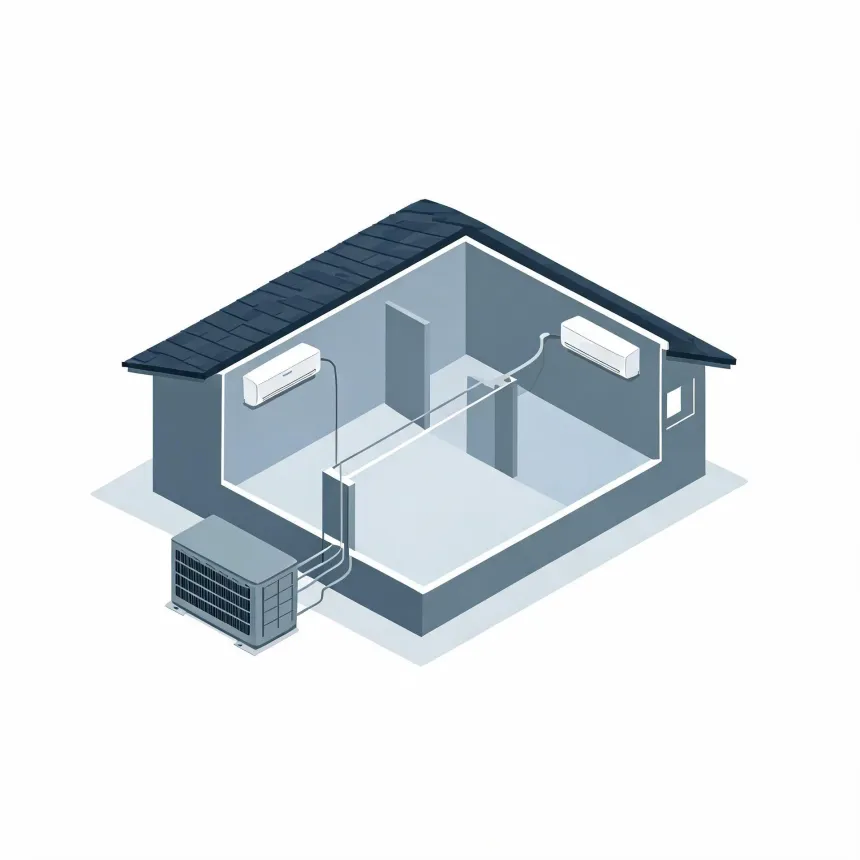
- A single outdoor unit can run one indoor head or several, depending on the system. Single-zone systems serve one room or open area. Multi-zone systems connect several indoor heads to one outdoor unit, each with its own thermostat, so bedrooms, a living room, and other spaces can each be set differently. How many zones your house needs depends on its layout and size, which a contractor has to walk through in person.
- Can a mini split heat a whole house?
- A mini split heat pump can heat a whole house if enough indoor heads are placed to cover every room that needs it. Palm Bay only needs heat in January, and winter nights average 54°F, well within what a heat pump handles without backup heat. The bigger question is coverage. A single head warms the room it's in and maybe an open area next to it, so a whole house usually needs a multi-zone setup or several units. A contractor can size the system to your floor plan.